The term “robot journalism” has largely disappeared from news headlines, though robot images still illustrate stories about AI in newsrooms. Meanwhile, a new metaphor has taken hold: the “AI agent”. Carl-Gustav Lindén and Laurence Dierickx from the University of Bergen argue that it attributes even more human agency to software, and that journalists and researchers alike tend to use it without asking what it actually describes.
In 2019 we published an article titled “Robot Journalism: The Damage Done by a Metaphor” https://helda.helsinki.fi/bitstreams/af8a401a-dba7-4e67-b052-b53b9792d82d/download in an obscure and now defunct student magazine at LSE, UnMediated.
It was born out of frustration.
In early June 2018, the European Federation of Journalists organised a meeting in Lisbon with the title “Robot journalism – should we be afraid?”. One of us was a member of the panel. The discussion followed a similar trajectory, with the main argument being repeated once again that journalists faced an existential threat.
The impact of new technology on journalism is certainly an enduring theme, and the threat of the robot, a mostly dystopian technosocial imaginary, goes back several decades.
An Old Fear in New Clothes
According to Latar (2018), one of the first mentions of robot journalism was in a newspaper column, Media Notes by the Washington Post reporter Howard Kurtz (2002) where he writes about the news aggregation service Google News, which was just launched. Kurtz’ reaction rings familiar even today: “Is news in the Net age just a bloodless compilation of electronic connections to global media outlets, allowing users to point-and-click their way to bleary-eyed nirvana? Or does it require sharp editing judgments, seasoned beat reporters, provocative columnists, and a small dollop of personality?”
Slate’s Jack Shafer was even more frank: “no team of human editors can compete with 24/7 robots”.
The empirical foundation of our article for UnMediated was a quantitative survey of the occurrence of the term ‘robot journalism’ in a corpus of 300 news articles in French and English over the period between 2010 and 2017. In those seven years, the metaphor saw massive use among journalists. In more than three out of four analysed headlines, the term ‘robot journalism’ was employed, which was a rate far higher than similar—and more specific—terms like ‘artificial intelligence,’ ‘algorithm,’ or ‘software’ (around ten percent).
The metaphor of ‘robot journalism’ was reinforced by a strong visual component. Everywhere we saw pictures depicting robots writing on keyboards, sometimes wearing a hat with the word ‘Press’ plastered on the front. Illustrators, together with journalists, editors, and researchers have by now established a basic heuristic, a mental picture of an evolving field as radical disruption.
Still in the Picture
Nine years later, we have conducted a similar analysis for our coming paper, “Revisiting the myth of the thinking machine: Artificial agency in reflexive journalistic discourse,” covering a corpus of 1,102 headlines published between 2018 and 2025.
Although the term ‘robot journalism’ has almost disappeared from the headlines (only used in less than five percent of the corpus), pictures used for representing the use of AI-based technologies in journalism are still conveying the metaphor. From the classic robot sitting in front of a typewriter to the cyborg dissolving the human in the machine, these images can take on two different meanings: a first and pragmatic one, which implies fruitful human-machine collaborations, and a second and more dystopian one, which suggests the control—or even the erosion—of human identity. Nevertheless, journalism is about popularisation. After all, our collective imagineries of AI technologies are rooted in ancient myths and contemporary fiction that have long staged the encounter between humans and their artificial creations (Herman, 2023). This is where the difference with academia theoretically lies: each term needs to refer to a precise concept.
Although the term ‘robot journalism’ has almost disappeared from the headlines (only used in less than five percent of the corpus), pictures used for representing the use of AI-based technologies in journalism are still conveying the metaphor.
Journalism scholars have used various terms to refer to journalism in which computational techniques assist human beings in news reporting, including ‘automated’, ‘algorithmic’, ‘AI journalism’ or ‘hybrid journalism’. Yet, these concepts are too often gathered under the digital imaginary of ‘robot journalism’—a dystopian metaphor that is problematic as an analytical term because it creates confusion and an unnecessary sense of existential threats to the profession. Thus, while scholars aim to make sense of what they perceive as a messy journalistic field, they simultaneously end up adding to the confusion (Loosen et al. 2022). Our collective sense-making is not helped by the use of the metaphor. We have heard otherwise smart people admit to knowing this is the case, while others claimed to tag their articles with “robot journalism” just to make sure they turn up in searches on, for instance, Google Scholar or Scopus.
What we ourselves saw was a move towards a future of augmented journalism, a concept inspired by the humanist engineer Doug Engelbart, where smart machines play a supportive role and allow reporters to do their jobs better. For a start, it would be of great help if we could talk about augmented intelligence instead of artificial intelligence.
There Are No Robots, Only Software
What followed after the article was published was a global campaign against the damaging metaphor. At conference after conference and lectures for students, we repeated the message: “There are no robots, only software,” and tried to establish a competing metaphor, the “washing machine”. Our plan was that a sociotechnical imaginary of washing machines as “thinking”, “self-aware”, “learning” would reveal the ridicule of the existential threat from “robot journalism”. What we now find out is that other scholars have picked up the absurd idea of “intentions of washing machines” (Harper, 2022). Correlation is not proof of causality and we take no credit for what happened, but our updated collection of headlines shows that journalists had gotten the message since the robot metaphor is fading away in news texts but still exists in illustrations.
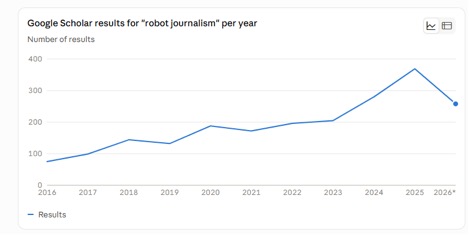
What happened next? First, it seems—contrary to journalists—researchers are increasingly using the bad metaphor, at least according to a quick check on Google Scholar. While “robot journalism” was mentioned in 75 articles ten years ago, the number grew about fivefold between 2016 and 2025, to 369. The growth was steady, with small dips in 2019 and 2021, and then sped up sharply in 2024–2025. That timing fits the surge of interest in AI and journalism after ChatGPT’s release in late 2022. The apparent drop in 2026 (marked *) is probably not a real decline, for two reasons:
– The year isn’t over. At today’s date, October 26, about 82% of 2026 has passed. If the current pace holds, the full year would reach roughly 315 results.
– Indexing lag. Google Scholar adds publications to recent years with a delay, so counts for 2025 and 2026 will likely rise if we check again in a few months.
Enter the Agent
What else happened? The AI agent, which is assigned the human agency that a robot obviously lacks, entered the scene. The agent by the usual definition is a person or entity legally authorized to act on behalf of the principal. In software, according to Cambridge Dictionary, it is an AI system “that can operate in a complicated way without human control and is generally used for making decisions rather than creating content.” A single execution from initial task input to final task output is called an agent run; thus, an agent is one model run one time. What is generally called agentic AI refers to multi-agents systems that are designed to achieve complex, multi-step objectives (Wang et al., 2024).
What began in early 2024 as a weak signal has now reached the mainstream with force.
What began in early 2024 as a weak signal has now reached the mainstream with force.
Here are just a few recent examples:
“What AI agents need from journalism: an explainer” is a story from Journalism UK https://www.journalism.co.uk/what-ai-agents-need-from-journalism-an-explainer/.
“AI agents lift newsroom output by 40% — but editors remain in charge”, informs Tomorrow’s Publisher https://tomorrowspublisher.today/news/ai-agents-lift-newsroom-output-by-40-but-editors-remain-in-charge-57bc40ea6ad9/index.html.
Mediaweek tells us that “AI agents could buy half of all ads by 2028: News Australia” https://www.mediaweek.com.au/agenticadvertising-org-australian-chapter-news-australia-paul-oyama.
Nieman Lab has the story on “Uber agents,” undercover AI personas, and other ways newsrooms are using AI in investigations https://www.niemanlab.org/2026/10/uber-agents-undercover-ai-personas-and-other-ways-newsrooms-are-using-ai-in-investigations/.
Fix Media also focuses on transformation: “How AI agents might change journalism, with Overtone AI’s Christopher Brennan” https://thefix.media/2026/09/03/how-ai-agents-might-change-journalism-with-overtone-ais-christopher-brennan/
These are articles written by journalists published in the industry press and should be more analytical than what you would expect from the average reporter. Columbia Journalism Review has repeatedly urged journalists to not buy the narrative by the tech industry; for instance, in this very good piece, “AI Can’t Really ‘Go Rogue’: How journalists writing about AI can avoid hyping the supposed humanity of machines” . Words like “agent,” “think,” or “understand” hide the reality that these systems are predictive statistical engines rather than conscious entities. https://www.cjr.org/ask-anika/so-can-ai-go-rogue-or-not-journalists-avoid-hyping-humanity-machines-openai-hugging-face.php.
But surely scholars have a better understanding than being swept away by the hype? We have no overview, but we find recent articles such as “Runtime configuration for situated governance of AI agents: a case study in investigative journalism” (Hagar & Diakopoulos, 2026) mentioning “agent” 167 times without explaining what an “agent” is. Maltezos et al. (2025) do provide a definition spiced with anthropomorphism: “An AI LLM Agent functions as a computational partner leveraging language models to interact in remarkably human-like ways.” Kraischan et al. (2026) manage to include both “robo-reporters” and AI agents in the title. AI agents are described as “genuine participants in the editorial process, fundamentally altering gatekeeping in contemporary journalism” but do not explain what species robots are.
Autonomy is Not Agency
Meanwhile, research in information science and AI ethics recognises agents for what they are: components of distributed decision-making chains that operate autonomously without agency. The anthropomorphisation of agents, treating them as acting entities that behave like humans, risks obscuring this distinction by encouraging the perception that autonomous action implies agency. Yet autonomy is not agency (Kahl, 2026). Agents can perform tasks, make selections and coordinate workflows without taking responsibility, exercising evaluative judgement or being held accountable. Treating them as if they do creates a misleading understanding of their role and contributes to the displacement of human authorship and responsibility. At the very best, they possess a form of artificial agency devoid of any human intelligence (Floridi, 2026).
Finally, we definitely agree with Usher (2026) who sees a need to “de-hype” the scholarly imagination associated with generative AI. Our next article will thus be titled “AI agents: the damage done by the next metaphor”.
References
Hagar, N., & Diakopoulos, N. (2026). Runtime configuration for situated governance of AI agents: a case study in investigative journalism. AI and Ethics, 6(5), 456.
Harper, R.R. (2022) Commentary: the intentions of washing machines, Human–Computer Interaction, 37:3, 248-250, DOI: 10.1080/07370024.2021.1976640
Hermann, I. (2023). Artificial intelligence in fiction: between narratives and metaphors. AI & Society, 38(1), 319-329. DOI: 10.1007/s00146-021-01299-6
Kahl, P. (2026). How continuity distinguishes autonomy from agency in agentic AI. Discover Artificial Intelligence. https://doi.org/10.1007/s44163-026-01675-5
Kraishan, O., Jitkajornwanich, K., & Kee, K. (2026). Robo-Reporters: Evaluating Autonomous AI Agents as Algorithmic Gatekeepers in Computational Journalism. arXiv preprint arXiv:2607.10736.
Kurtz, H. (2002) Robotic Journalism: Google Introduces Human-Less News. The Washington Post. (https://andrewcoile.com/CSUMB/2002/fall/CST373/scrapbook/robotjournalism.pdf)
Floridi, L. (2025). AI as Agency without Intelligence: On artificial intelligence as a new form of artificial agency and the multiple realisability of agency thesis: L. Floridi. Philosophy & Technology, 38(1), 30. https://doi.org/10.1007/s13347-025-00858-9
Latar, N. L. (2018). Robot journalism. In Robot Journalism: Can Human Journalism Survive? (pp. 29-40). World Scientific Publishing Company. New Jersey.
Loosen, W., Ahva, L., Reimer, J., Solbach, P., Deuze, M., & Matzat, L. (2022). ‘X Journalism’. Exploring journalism’s diverse meanings through the names we give it. Journalism, 23(1), 39-58.
Maltezos, V., Kyrychenko, R., & Knuutila, A. (2025). How can AI agents support journalists’ work? An experiment with designing an LLM-driven intelligent reporting system. arXiv preprint arXiv:2510.01193.
Usher, N. (2026). Generative AI and journalism: Hype, the always already new, and directions for scholarly imagination. Digital Journalism, 14(2), 400-409.
Wang, L., Ma, C., Feng, X., Zhang, Z., Yang, H., Gao, J., Chen, Z., Tang, J., Chen, X., Shen, Y., Zhu, W., & Zhao, D. (2024). A survey on large language model based autonomous agents. Frontiers of Computer Science, 18(6), 186345.https://doi.org/10.1007/s11704-024-40231-1
Image: Screenshot: https://tomorrowspublisher.today/news/ai-agents-lift-newsroom-output-by-40-but-editors-remain-in-charge-57bc40ea6ad9/index.html