After this year’s ECREA conference, I want to share one lesson from beyond the packed academic programme: If you are a senior scholar and see someone standing alone, go and talk to them. It may take only a minute of your time, but they might remember it for the rest of their career.
Academic conferences are celebrated as spaces for exchange – and rightly so. We reconnect with old colleagues, discuss questions that matter to us, catch up on what has happened since we last met, and sketch out future plans over coffee. We enjoy being among our academic friends and family. Within a few intense days, it is easy to fill one’s social calendar, or sometimes to even exhaust one’s capacity for sociability altogether.
The recent ECREA 2026 conference brought almost 3,400 media and communication scholars to the charming Czech city of Brno. As the largest European gathering in the field, it offered an extraordinary concentration of knowledge.
Being constantly busy is a sign of academic seniority. The moment you say goodbye to one colleague, another appears around the next corner. Your schedule is filled with chairing sessions, commenting on papers, attending meetings, and making arrangements. There is barely a minute left – and this scarcity itself signals that you belong.
Of course, it is natural to gravitate towards familiar colleagues. Researchers working in different countries rarely meet in person, so conferences become occasions for reunion. National clusters also emerge: Swedes find other Swedes, and Germans find other German-speaking fellows. Longstanding research networks reassemble around tables, in corridors, and at evening receptions.
For a newcomer, however, these groups can appear almost impenetrable.

From connection to inclusion
Young scholars may have travelled a long way and spent scarce research funds to give a ten-minute presentation, followed by a few hurried comments that are not always that useful. They enter crowded receptions where everyone seems to recognise everyone else. Standing alone with a coffee cup, they may begin to wonder why they came at all.
Conferences do, of course, create opportunities for early-career researchers. ECREA has YECREA, its network for young scholars. We in ECREA’s board have put considerable effort in EDI (equity, diversity and inclusion), recognising people’s under-represented status in terms of age, disability, gender, ethnicity and race, religion and belief, sex and sexual orientation, as well as supporting their academic status and working conditions, their parental status, and parental and caring commitments. Panels frequently include doctoral researchers, and younger voices may even be invited to prominent events, as they were at this year’s keynote roundtable.
Representation on the programme matters – but it does not automatically produce social inclusion. Connection must also be supported methodically and systematically, in those everyday encounters that unfold during the conference days.
Conferences could organise speed-networking sessions, meet-ups for first-timers, mentoring pairs, newcomer tables, small thematic lunches, or structured introductions before receptions. Session chairs could invite participants to continue their discussion together after the panel. Senior scholars could be encouraged to bring an early-career researcher into at least one conversation or introduce them to at least one person working on a related topic.
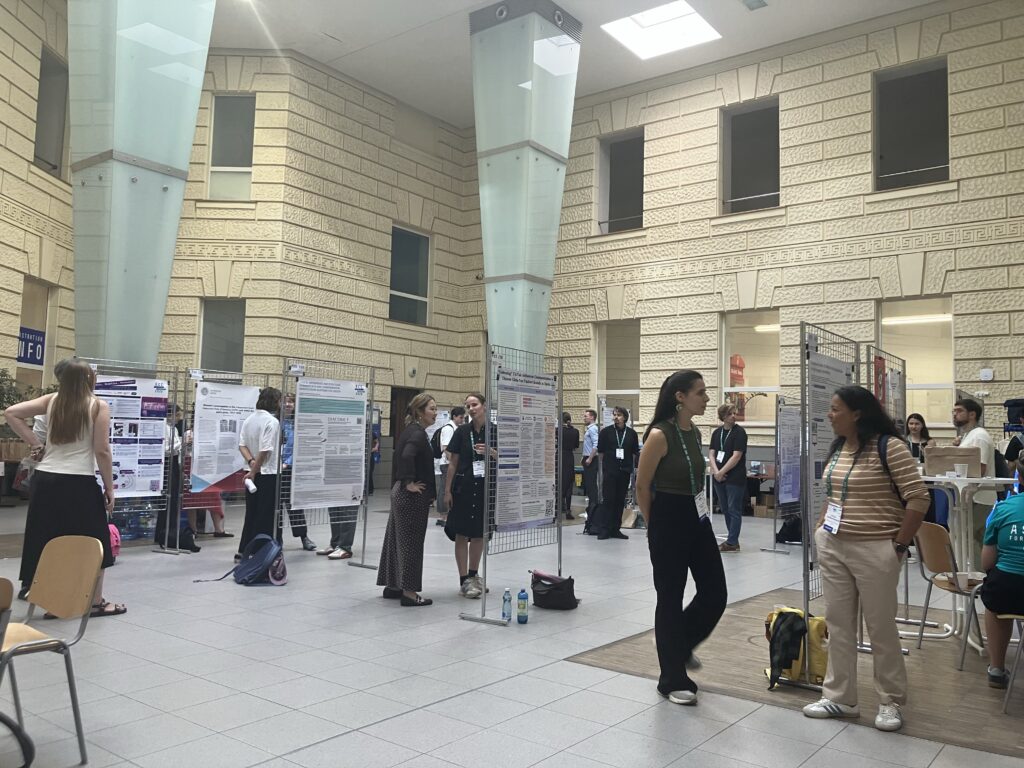
Poster exhibitions are also an underrated opportunity for intergenerational academic encounters.
But institutional arrangements cannot replace individual action. The simplest intervention remains remarkably powerful: notice who is alone.
Invite that person to join you. Ask what they are working on. Connect them with someone they might benefit from meeting, and explain why you think they should know each other. Do not assume that networking skills come naturally and remember that young scholars may feel intimidated when approaching established senior colleagues.
At ECREA, I did see many seniors approaching juniors or the other way around. Yet my conversations with first-timers and ex-first-timers in Brno especially reminded me of how powerfully consequential a small gesture can be. The younger researcher may remember it for years: as the moment the conference began to make sense, the discipline became accessible, and they felt that there might be a place for them within it.
At a conference, inclusion does not begin with another policy statement. It begins when someone crosses the room.
Photos: Maarit Jaakkola