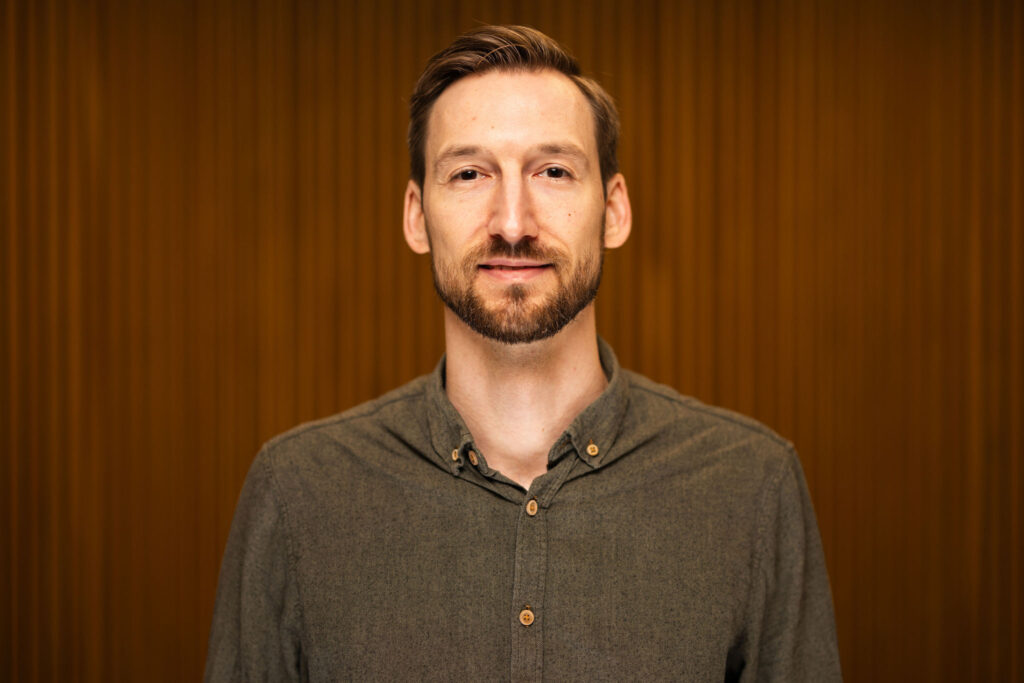
Why are politicians, social media users, and even AI systems increasingly turning to the past? According to Associate Professor Manuel Menke, the answer may lie in a present marked by rapid change, uncertainty, and growing concerns about the future.
We spoke with Manuel Menke, co-editor of the latest issue of Nordic Journal of Media Studies, which explores the relationship between media and the past. The issue brings together contributions on topics ranging from populist politics and sportswashing to queer memory, AI-generated narratives, and online subcultures.
The motivation behind creating the issue emerged partly from a Nordic research project examining political uses of the past in party communication. But for Menke, the topic reaches far beyond electoral politics.
“We see it everywhere”, he says. “From popular culture, where we see a lot of focus on old media content and technologies being revived and reused, to politics and online communication”.
One possible explanation, according to Menke, is that many people are struggling with the pace of change and feeling increasingly concerned about the future. In that context, the past can offer something familiar.
Many people are struggling with the pace of change and feeling increasingly concerned about the future. In that context, the past can offer something familiar.
“We are feeling a bit more comfortable and at home when thinking about the past, which gives us a sense of control when things around us seem to be increasingly out of control”, he explains.
Whose Past Gets Remembered?
One of the interesting things about the issue is the wide range of topics it covers. The articles examine everything from sportswashing and populist politics to marginalised memories and digital technologies.
When asked whether there was a common thread connecting these seemingly different topics, Menke immediately points to questions of identity and power.
“We only understand ourselves by understanding where we come from”, he says. “The same is true on a collective level. Societies make sense of themselves through stories about the past”.
Many of the articles, he explains, explore how different groups use the past to understand who they are, where they come from, and how they arrived at their current position in society. They also raise questions about visibility and recognition.
“The problem in every society is that the overlooked pasts are usually those of more vulnerable groups”, Menke says.
“It should be a goal of every democracy to include as many perspectives and voices as possible”, he says. “Knowing about the past of other groups is a sign of inclusion and respect towards other groups and their needs in society”.
Media as memory-makers in the age of AI
In the Introduction to the issue, Menke and his co-editor Marie Meier argue that media are not merely channels through which memories travel: They are active spaces where the past is shaped, negotiated, and debated.
When asked why media and communication scholars should pay particular attention to these processes, Menke points to a simple but important observation:
“When you think about what the past is, it is what we cannot observe in the here and now”, he says. “It has to be mediated. If the past is not mediated, it is forgotten”.
For Menke, media are therefore much more than channels for storing or transmitting memories. They shape how people access the past and influence which versions of it become visible in public discourse. These questions, he argues, become even more important as digital platforms and artificial intelligence play a growing role in how information is produced and circulated.
One of the articles in the issue examines how large language models generate narratives about the past. Menke believes AI raises many of the same concerns that already exist around platforms and algorithms, particularly when it comes to who controls these technologies and whose perspectives they represent.
AI raises many of the same concerns that already exist around platforms and algorithms, particularly when it comes to who controls these technologies and whose perspectives they represent.
“It’s always good to be sceptical of technologies that are in the hands of very powerful entities that are more interested in their economic success than in contributing to a healthy public discourse”, he says.
At the same time, he argues that discussions about AI and history cannot be reduced to questions of factual accuracy alone.
“We have an AI that is giving us one version influenced by what we prompt”, he says. “The big question still is: Which version is that?”
The difficulty, Menke explains, is that collective memory is rarely a matter of a single agreed-upon truth. Historical facts may be established, but societies continuously debate what those facts mean and how they should be remembered.
As AI systems become increasingly influential sources of information, understanding how they construct and present narratives about the past will therefore become an important task for media researchers.
Looking to the Future
Menke is particularly enthusiastic about the journal’s forthcoming issue on “Media and Futures”, which he sees as a natural companion to the current volume.
“It almost feels like a crime to separate them”, he says with a laugh.
“Whenever you do something about the past, there’s always the question why it matters today”, he says. “It matters because in the present, we are trying to understand how we got here and what the best way forward looks like. Past, present, and future inform each other and on their own they don’t tell us the whole story”.
That is also why he believes the current issue matters. While media and communication research is often fascinated by emerging technologies and future developments, understanding where societies are heading requires attention to where they have come from.
The issue Media and the Past: Mediating the Past serves as a reminder that neither direction can be fully understood without the other.
Read more
Nordic Journal of Media Studies
Editors: Manuel Menke and Marie Meier
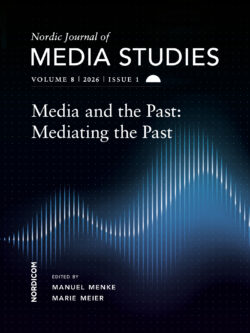
Photo: Adobe Stock