Algorithms increasingly influence which news stories reach us, what information we encounter, and ultimately how we see the world. But how much do we really understand about the systems making those choices? Jannie Møller Hartley has spent years researching algorithms from inside news organisations. In this interview, she talks about entering the world of machines, why algorithms are less mysterious than we might think – and why we should all pay more attention to them.
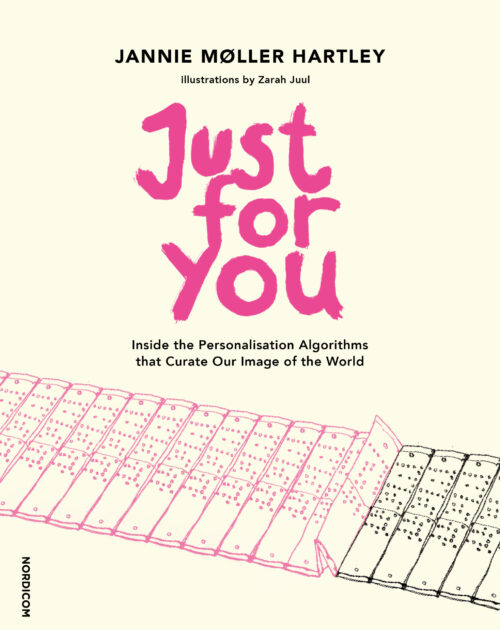
Jannie Møller Hartley’s new book, Just for You: Inside the Personalisation Algorithms that Curate Our Image of the World, is not a traditional academic book. Research and fieldnotes are mixed with history, storytelling, and illustrations, taking the reader along on Hartley’s own journey into the world of algorithms.
When I met with Hartley to speak about the book, I was particularly curious about one person who appears throughout the story: Ada Lovelace.
Hartley tells me that she came across the nineteenth-century mathematician while reading about the history of algorithms. At the same time, she was doing fieldwork in environments where algorithms were being developed – environments largely dominated by men.
“Then suddenly this female figure popped up and I started sort of reading up on her life”, Hartley says.
The more she read, the more connections she began to see. Lovelace had entered a male world of machines and tried to understand their language. More than a century later, Hartley found herself in a surprisingly similar position.
“She was, of course, also an outsider to the world of algorithms and machines. And I was an outsider as well”.
Entering the World of Machines
The story begins in 2019, when Hartley started her fieldwork. At the time, news organisations were beginning to talk more seriously about personalisation. The idea was already familiar from platforms such as Netflix, which offered content tailored to individual interests. But now Hartley could see similar systems entering the news media environment.
“I thought, my God, this is going to transform how we as citizens get informed”, she exclaims. “It’s going to affect how our democracy is shaped, how our image of the world is curated”.
As a former journalist herself, she had spent years researching the digital transformation of news. She entered the news organisations expecting to find out how these new systems were changing the work of journalists.
“I entered the news organisation thinking that I would be observing the journalists”, she explains. “That’s what I’ve always done. It’s what I know”.
But that wasn’t quite what happened.
As she made her way through workshops and project meetings, she realised that she was hardly meeting any journalists at all. Instead, much of the development was happening elsewhere in the organisations.
“All of this machine development, it takes place in other places than journalism”, she says.
When I ask her about that moment of realisation, she describes suddenly finding herself among developers who spoke a very different language from the one she knew.
“I was like, okay, I’m going to enter a whole different species of people”, she recalls. “These are people that don’t speak my language of journalism. These are people that speak in this code”.
When Algorithms Help Decide What We See
As we talk about what this shift means for journalism, she describes it as an “adaptive turn”. Decisions that were traditionally made by journalists and editors can increasingly be built into technological systems. Systems that adapt to users’ behavoir and choices every minute.
The front page of a newspaper, for example, was once shaped by an editor deciding which stories people needed to know about. With personalisation, different users may instead be shown different stories based partly on their interests and previous behaviour.
“We would get the kind of the information that the systems think we need and with AI it will also predict what we might like in the future”, Hartley says.
She compares it to streaming platforms: Watch one kind of film and you are likely to be offered more like it. News can increasingly be distributed according to similar logics.
This is not necessarily a problem in itself, she stresses. But it means that media users need to become more aware of why they are seeing certain information.
“We need to ask ourselves why we are being offered this kind of news story”, she asserts.
Taking Away the Mystery
When I ask why it is so important to remember that algorithms are built by people, she points to the way we tend to talk about them as if they were forces of their own.
“We have a tendency to make algorithms into these mysterious forces that almost magically act on their own”, she says.
Instead, she offers a much simpler image.
“It doesn’t do anything it hasn’t been told to do. It’s like a recipe. Someone has made that recipe, someone has put in what sort of ingredients should go into the recipe. And you are also part of baking the cake”.
This desire to make technology less mysterious also shaped the way she wrote the book. She wanted to reach beyond the academic audience and take readers with her as she tried to understand a world that was initially unfamiliar to her too.
“I wanted people to engage in the same journey that I had been on myself”, she says. “I wanted people to be put in my space, if you know what I mean, and to be with me on that journey into the machines”.
Ultimately, she hopes the book will leave readers more curious about the technologies around them – and more willing to question how they work. Understanding these systems also means recognising that they are not simply given to us.
“We can build these systems. We can envision them in the way that Ada did. We can build them differently”.
And so, our conversation returns to Ada Lovelace. For Hartley, the history of algorithms is also a reminder that technologies have always been imagined and built by people – which means there is still room to discuss what values we want them to reflect.
“They’re not given. They can be designed, but we need to start the conversations about how we want the machines to be designed and with AI this question becomes even more urgent”, she concludes.
Read more
Just for You: Inside the Personalisation Algorithms that Curate Our Image of the World