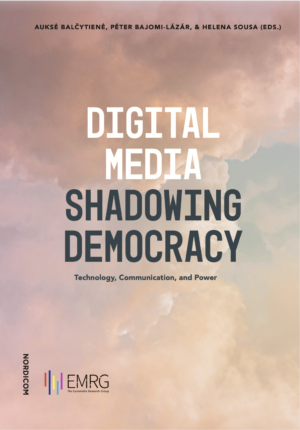
A new edited volume explores how platformisation, social media, and digital infrastructures are reshaping democratic societies, raising questions about power, responsibility, and what it means to be an informed citizen.
Digital media have become central to the functionality of democratic societies. In a new edited volume, Digital Media Shadowing Democracy: Technology, Communication, and Power, editors Auksė Balčytienė, Péter Bajomi-Lázár, and Helena Sousa bring together perspectives on how platformisation and digital media are transforming public life – from journalism and political participation to the broader information sphere.
When speaking with the editors, they describe that the idea of the Euromedia Research Group members exploring these topics emerged through the engagement in the EuromediApp project. What began as a series of discussions on social media, disinformation, and changing communication practices gradually developed into a more systematic effort to understand what they describe as the “shadowing” of democracy.
“We felt that these discussions needed a more structured form”, they explain. “The book is an attempt to bring together different perspectives on how digital media are reshaping public communication and, in turn, democratic life”.
From Informed Citizens to Complex Information Environments
One of the key shifts highlighted in the book concerns the changing meaning of “being informed”. For decades, democratic theory has relied on the idea of an informed public, supported by journalism as a central institution. Today, that model is increasingly difficult to sustain.
“The information sphere today is far more complex and far more diverse”, the editors note. “It includes not only journalism and expert knowledge, but also alternative narratives, peripheral perspectives, and disinforming or manipulative messages”.
This complexity is further shaped by the growing role of algorithmic systems and AI, which influence how information is selected, distributed, and presented. As a result, understanding the information environment now requires attention not only to content, but also to the structures and technologies behind it.
At the same time, the editors point to a widening gap between how these changes are experienced and how they are studied. While individuals encounter the effects of digital media in their everyday lives, many of the underlying processes remain difficult to see.
This, they argue, calls for new ways of communicating research and engaging the public.
“A more sustainable dialogue is needed, one that not only listens to people, but also returns to them over time, re-engaging them and reassessing how their understanding and responses develop over time”.
This volume is part of the effort to bring communication scholars’ findings on the societal impacts of social media platforms closer to the general public, and especially students of communication and media studies and journalism departments.
Power, Responsibility, and Democratic Resilience
Across the volume, democracy is described as being under increasing pressure, particularly as core systems of knowledge and information are being challenged. New actors, including influencers and content creators, play a growing role in shaping public opinion, often without adhering to established journalistic norms.
This development is part of a broader shift in the balance of power within the digital media environment. Responsibility is no longer concentrated in a few institutions, but distributed across a wide range of actors, from platforms and policymakers to users themselves.
“If this is to work in a participatory way, responsibilities must also be shared. But this requires new forms of dialogue and a better understanding of how these different actors operate”, they explain.
At the same time, the editors emphasise that responses to these challenges must go beyond regulation alone. While policy initiatives such as the Digital Services Act and the European Media Freedom Act are important, they do not in themselves guarantee meaningful change.
Instead, the book points to the need for broader societal responses, including stronger media literacy, more critical engagement with digital technologies, and renewed attention to the role of journalism and other knowledge institutions.
“We believe people need to reclaim ownership of their minds. This means developing greater awareness, critical thinking, and the ability to understand how the digital environment shapes what we see and how we think”, the editors conclude.
Read more
Digital Media Shadowing Democracy: Technology, Communication, and Power