A new special issue of Nordicom Review examines how extremism is evolving in the Nordic countries, highlighting the role of social media, hybrid forms of engagement, and the growing difficulty of defining extremism in digital platform environments.
In recent years, concerns about online extremism have intensified across Europe. While the Nordic countries are often characterised by relatively high levels of institutional trust and democratic stability, digital platforms are reshaping how extremist ideas emerge and circulate. These developments are at the centre of a new special issue of Nordicom Review on online extremism in the Nordic countries, edited by Associate Professor Line Nybro Petersen and Postdoctoral Researcher Mikkel Bækby Johansen, both at the University of Copenhagen.
Speaking with Line and Mikkel, they describe the project as rooted in a broader European research collaboration. The idea, Line explains, grew out of their involvement in a Horizon Europe project on extremism and social media.
“We wanted to understand what this landscape looks like in the Nordic countries. We don’t see the same levels of extremism here as in other parts of Europe, but that doesn’t mean these dynamics do not exist. The role of social media has changed how these narratives spread, and how these communities are able to coordinate and manifest online”, she explains.
For Mikkel, the timing of the special issue is also related to the pace at which the field is changing.
“This landscape is developing quite fast, and new types of extremism keep emerging. It’s also a very interdisciplinary field, where many scholars recognise that there are media-specific dimensions, but they don’t necessarily address them head-on”.
Both editors also point to a gap in existing research: While the role of social media is widely acknowledged, its specific influence remains underexplored – something the special issue seeks to address.
Hybrid forms of extremism
A key concept running through the issue is what Line and Mikkel describe as hybrid forms of extremism. As Mikkel explains, this reflects a broader shift also observed by intelligence services across Western countries.
“Motivations are often mixed, unstable, and unclear, which really challenges traditional understandings of extremism. It’s something intelligence services are pointing to as well, that these forms don’t fit neatly into existing categories”.
For Line, this hybridity is not only about ideology, but also about how extremism takes shape within digital media environments.
“It’s not only the ideology that is hybridised, but also the aesthetics and the practices and the technologies. Something may look like a fitness influencer or a health influencer, but then it’s mixed with more extreme ideas or conspiracy narratives”.
In this way, platform cultures shape how extremism is expressed and embedded in everyday online environments. This also complicates how extremism is defined.
“Extremism is almost by definition a grey area. Extreme views are not necessarily the endpoint of a process of radicalisation – they can be temporary, partial, or even a precursor to something else”, Mikkel says.
The Nordic Context and Missing Perspectives
Looking across the contributions of the issue, Line points to a high degree of similarity across the Nordic countries. While the cases span different national contexts, many of the patterns identified appear to travel easily across borders.
“There’s a lot of transferability”, she explains. “The trends we see in Finland or Sweden could just as well be found in Denmark or Norway”.
At the same time, both editors emphasise that research on extremism in the Nordic region remains relatively limited. While the special issue brings together a range of perspectives, it also reflects the fact that the field is still developing.
They also point to perspectives that are less visible in the current issue. Much of the research, for example, focuses on emerging dynamics and online cultures rather than specific events or acts of violence.
“You could imagine studies looking at how social media is used before or after attacks”, Line says. “But here, the focus is more on the underlying mechanisms and the developments that come before”.
Mikkel adds that this imbalance also reflects a broader trend in the field.
“There is far more research on far-right extremism”, he notes. “Other forms are much less studied, so it would have been valuable to include more of those perspectives as well”.
Implications and Future Directions
When asked what they hope scholars, policymakers, and the broader public will take away from the special issue, both editors point to the need for a more nuanced understanding of extremism as a dynamic and socially embedded phenomenon.
“It’s not only about hate or violence, it’s also about community and identity, and the ways people spend time online. People can move in and out of these spaces, and that makes it much more complex”, Mikkel explains.
For Line, recognising these dynamics is particularly important for those working with prevention and regulation, especially as motivations behind harmful actions appear to shift.
“One of the challenges is that motivations don’t always look the way we expect them to. They can be tied to community practices or certain aesthetics that make participation more intense”.
At the same time, both editors emphasise that these developments pose challenges for research itself, calling for approaches that better account for the role of media environments.
“Some of these new trends don’t match classical understandings of extremism”, Line concludes. “So, the question is whether we need new categories or at least to rethink the ones we have”.
Read more
Nordicom Review special issue
Edited by: Line Nybro Petersen and Mikkel Bækby Johansen.
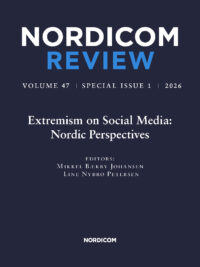
Photo: Adobe Stock